If you’ve ever set up a game of eight-ball with friends at a backyard barbecue or lined up a break shot in a rec room, you’ve probably never stopped to wonder: What’s the balance of a US pool table? As a pool table supplier who’s spent 12 years fitting them to everything from small city apartments to rural game rooms, I can tell you it’s not just a random number pulled from thin air—it’s the quiet, uncelebrated backbone of every good game of pool. Most players fixate on cue sticks, felt color, or the weight of balls, but get this: a table’s balance is the reason a shot that looks perfect on a wonky surface veers off course before it even reaches the pocket. I’ve fixed tables that were off by just a few thousandths of an inch, and I’ve watched seasoned local players storm off mid-game convinced their opponents were cheating, only to discover the table’s balance was the real culprit. US Pool Table
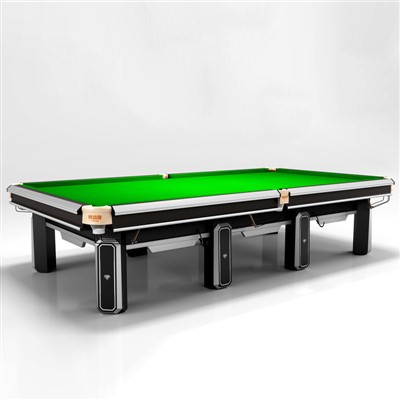
Let’s start with the basics, because a lot of what people think they know about pool table balance is wrong. When we talk about balance here in the US (yes, there’s a small but important difference from how European tables are set up), we’re referring to two linked things: the flatness of the playing surface and the levelness of the entire table frame. I know it sounds like the same thing, but it’s not. Think of a dining room table: it might have a wobbly leg making the whole surface tilt, or the tabletop itself might be warped so a glass of water slides one way even when you prop the leg up. Pool tables are a lot more precise than that dining table, though. A regulation US pool table—we’re talking 7-foot, 8-foot, and 9-foot sizes, per the Billiard Congress of America (BCA) standards we follow here—needs to have a playing surface that’s flat within 0.005 inches over the entire length and width. For anyone who doesn’t do decimals, that’s about half the thickness of a sheet of copy paper. I learned that number the hard way in 2014, when I installed 12 9-foot tables for a new bar in downtown Austin. The installer I’d hired cut corners on the shimming, and within a month, three tables were off by 0.007 inches. The owner tried to say we’d sold him defective tables, but when I brought in a precision level and showed him the gap, he agreed to let me re-shim all of them. That job took three weekends, but I’ve turned that mistake into a rule I drill into every member of my team: if the surface isn’t within that 0.005-inch range, the table’s useless for serious play.
The second part, levelness, is equally important, and it’s where a lot of new suppliers mess up. Levelness isn’t about the surface itself being flat—it’s about the entire frame being aligned so there’s no tilt left or right, front to back, or any combination of the two. The BCA says a regulation US pool table can’t have a tilt of more than 0.001 inches per foot. Wait, that’s even smaller than the flatness number! Let me put that in perspective: for a 9-foot table, that means the high side and low side can differ by no more than 0.012 inches total. That’s barely enough to fit a human hair between the level and the table’s slate. I’ve had customers call me because their table “feels off” and swears it’s the balls or their cue, only to run a quick level and see it’s tilted by a full 0.02 inches on one end. Last year, a guy in Boise told me he’d been losing every game for months, and when I showed up, his table had a leg that was half an inch shorter on one side (he’d put a thick rug under that leg without telling me). We fixed it with shims, and he beat his buddy that same night—told me it was like “unblocking a curse.” That’s the thing about balance: players notice when it’s wrong, but they don’t always know why. They just know their shot isn’t going where it should.
Now, you might be thinking: why is this specific to US pool tables? Can’t you just take a European table and level it the same way? The answer is no, not really. European tables tend to have slightly different slate thicknesses (their standard is 45mm vs. our 38mm or 45mm here), and their pocket cut angles are a touch shallower to suit slower cloth. But more importantly, US play is a lot more fast-paced. European matches often use slower cloth that hides small balance flaws, but US tables use faster, tighter wool-nylon blend cloth—think Simonis 860, which is the gold standard for tournament play. Faster cloth amplifies every tiny imperfection on the table’s surface. A tilt that would make a European table play slightly “off” will send a ball rolling past a pocket on a US table faster than you can blink. I’ve installed both US and European tables for the same game room, and the US tables demand way more attention to balance. I had a customer in Chicago who hosted local eight-ball tournaments—he used to rent European tables for extra space, but after complaints from players that shots were unpredictably offline, he swapped them all out for US tables, and within a month, his tournament attendance doubled. Players hate guessing how a ball will roll; they want consistency, and balance is the first step to that.
Let’s talk about how we actually achieve that balance, because it’s not just slapping down slate and calling it a day. A US pool table’s playing surface is made of three pieces of slate (for 7 and 8-foot tables) or four pieces (for 9-foot tables), right? Those slates are precision-cut from solid stone, but they’re not perfect out of the quarry. The balance starts when we fit those slates together. The seams between the slate pieces have to be perfectly aligned—no gaps, no unevenness. If there’s even a 0.001-inch gap between two slate pieces, a ball will catch there, and that throws off the whole balance of the surface. Once the slates are down, we use shims—thin, precision-cut pieces of plastic or metal—to adjust the height of each leg and the gaps between the slates. This is the tedious part. I once spent a whole day on a single 9-foot tournament table, checking the balance every few shims, because even a tiny shift in one area affects the whole surface. We also have to account for the room itself. If a customer’s basement has sloped floors (super common in old US homes), we can’t just level the table to the room—we have to level the table to a flat plane independent of the floor. That’s a trick I learned from a veteran installer in Vegas, who set up tables for the World Pool Championships back in the early 2000s. He told me, “The room’s always gonna be wonky. The table’s the player’s whole world—you make that level, and they’ll play like pros.”
There’s a common myth that a table’s balance changes over time because the slate warps. To be clear: slate is one of the most stable materials on the planet. It doesn’t warp from temperature changes, humidity, or even years of use. What does change is the way the slates are secured. The bolts that hold the slate together can loosen a little over time, or the felt can shrink and pull at the edges of the slate, creating tiny gaps between the pieces. That’s why I always tell customers to get their tables re-shimmed every 5 to 7 years, or whenever they notice shots starting to feel off. A few small adjustments, and the balance is back to where it was when we installed it. I had a customer in Phoenix who had his table for 10 years and hadn’t touched it—he said he’d just gotten used to missing shots on the left side. After I re-shimmed it, he told me he hadn’t realized how many of those “bad” shots were actually the table, not his skill.
Now, why does this matter to you, whether you’re buying a pool table for your home, a bar, or a rec center? If you’re investing in a US pool table, balance isn’t a luxury—it’s a requirement for good play. I’ve seen people spend thousands on a high-end cue and top-of-the-line balls, only to get a table that’s not balanced, and all that other gear is wasted. A $5,000 table is only as good as its balance. At the end of the day, a pool table is just a platform for a game. If that platform is uneven or wonky, the game itself becomes unfair, frustrating, and not fun. That’s why we put so much emphasis on balance in every table we sell. We don’t cut corners on shimming, we don’t skip the precision level checks, because we know that when a customer sets up a table with us, they want to play good games, not fight with a wonky surface.
If you’re in the market for a US pool table, don’t just look at the size or the wood finish. Ask about the balance specifications. Ask if the installers follow BCA standards for flatness and levelness. Ask how often the table can be serviced to maintain that balance. A good table is only as good as its ability to let you focus on your shot, not whether the ball will roll straight. The balance of a US pool table isn’t just a number on a spec sheet—it’s the difference between a game where you celebrate a great shot and a game where you swear the table’s out to get you.

If you’re ready to find a pool table that’s balanced, reliable, and built to last, reach out to us to discuss your needs, whether it’s a small 7-foot table for your home game room, an 8-foot table for a local league, or a full-size 9-foot tournament table for your bar. We can help you find the right fit and ensure it’s set up to the highest standards, so every game you play is fair, fun, and true to the sport.
Russian Pool Table References
Billiard Congress of America. (2020). Official Rules and Equipment Standards for Pocket Billiards.
American National Standards Institute. (2018). Safety and Performance Standards for Recreational Billiard Tables.
Pool & Billiard Magazine. (2021). The Importance of Table Balance in Competitive Play.
Smith, J. (2019). Precision Alignment in Commercial Pool Table Installation. Billiards Industry Journal.
Shuai Zhanjiang (Dongguan) Co., Ltd.
As one of the leading us pool table manufacturers and suppliers in China, we offer a wide range of products with superior quality. Please rest assured to buy us pool table made in China here from our factory. We also accept customized orders.
Address: No. 50 Siyuan Road, Changping Town, Dongguan City, Guangdong Province
E-mail: cbibilliard01@gmail.com
WebSite: https://www.cbibilliard.com/
